
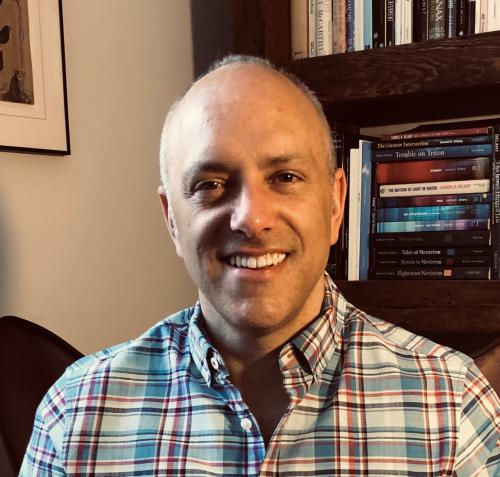
Professor of English
Office: Academic Building 6115; office hours by appointment
Professor Kurnick’s research and teaching focus on the history and theory of the novel, nineteenth century anglophone and European literature, contemporary Latin American fiction, sexuality and gender, and criticism and its publics. The thread linking these domains is a concern for the relation of literary form to collective life. The CCA, one of Rutgers’s key spaces for collective intellectual inquiry, has been central to his work since he joined Rutgers in 2007: in addition to participating as a faculty fellow in the research seminars on New Media Literacies, Formalisms, and The Commons, he co-ran the 2014-15 seminar on “Totality” with Rebecca Walkowitz.
His first book, Empty Houses: Theatrical Failure and the Novel (Princeton, 2012), examines the theatrical ambitions of major nineteenth-century and modernist anglophone novelists known for their explorations of domestic and psychological interiors to argue that the novel, frequently taken as a proponent of inwardness, prompts us to public ways of imagining the psyche, intimacy, and sexuality. His second book, The Savage Detectives Reread (2022) appeared in Columbia University Press’s “Rereadings” series, which features book-length examinations of major works of fiction from the last half-century. The book looks at the controversies surrounding Roberto Bolaño’s 1998 novel to reconsider the politics of cross-cultural literary appreciation. Excerpts of The Savage Detectives Reread appeared in The Paris Review and Bookforum. His current project, “The Erotics of Large Numbers,” explores how nineteenth-century realists like Austen, Balzac, George Eliot, and Benito Pérez Galdós conceive of mass experience in eroticized terms. Parts of the project have appeared in New Literary History and The Cambridge Companion to Narrative Theory.
His work in queer theory has focused on that field’s productive and sometimes tense intersection with the methods of literary study. He’s explored this topic in a series of essays: “A Few Lies: Queer Theory and Our Method Melodramas” (in English Literary History, 2020; an excerpted version appeared in The Chronicle of Higher Education); “Is There A Gay Literature of Poverty?” (in Politics/Letters), and most recently “The Beauty of Queerness: Notes on Sexuality and the Literary in the Long 1993” (in New Literary History, 2024).
Kurnick also works as a translator from Spanish and a critic of contemporary fiction. His translation of Julio Cortázar’s 1975 novella Fantomas versus the Multinational Vampires was published by Semiotext(e) in 2014 and was a finalist for the University of Rochester’s Best Translated Book Award. His essays about contemporary novelists like Elena Ferrante, Fernanda Melchor, César Aira, Rodrigo Rey Rosa, Allan Hollinghurst, Sergio Pitol, and Mariana Enríquez have appeared in Public Books, Bookforum, Politics/Letters, Full Stop, Reading in Translation, and ASAP/J.